Working with a Ghostwriter – What You Need to Know

You might have a book inside you, waiting to be written, yet lack the time, desire or discipline to sit down and put pen to page. Dana Micheli explains that’s where a ghostwriter comes in.

Ghostwriter Tina Dietz Twin Flames Studios

There is a saying that everyone has at least one book in them; however, not everyone has the time, desire or discipline to sit down and write it. That’s where a ghostwriter comes in. Here are some tips for finding the right person to get that story out of your head and onto the page.

As with any investment, you want to engage in some due diligence before beginning your search for a ghostwriter. Research the average length of the sort of book you want to write, typical ghostwriting rates, and what is included (for example, additional research or a book proposal). You should learn enough to prepare a list of questions before meeting with someone to discuss your project.

Choosing a writer

Ghostwriting is a highly collaborative process, one that requires trust and compatibility. You’ll likely be providing this person with deeply personal or proprietary information, so you want to make sure you have a rapport with them. Healthy communication is key. You always have final say over what goes into your book and what’s “off the record”; this means that while a good ghostwriter will offer you their opinion, they should never push you into including something you’re not comfortable with. Also keep in mind that some details may be problematic from a legal standpoint. A ghostwriter is not a lawyer and should not be relied upon as such; however, they should be able to point out red flags with regard to certain names or facts and advise you to exclude them, change them, or consult an attorney.

Some things to discuss when interviewing a ghostwriter

  • What does their process look like? I interview someone at least twice at the beginning so I can get enough information to create the book outline and, more importantly, get a sense of their voice. Once the outline has been finalized, I let the client decide whether they would like to deliver the rest of the content/messaging through interviews, material they have written, or audio files they record on their iPhone when they feel inspired. They must also be available to answer any questions I have about the subject matter, and review the material as I send it. Asking about the process will give you a good idea of your time commitment to the project.
  • Writing samples and references: While it certainly makes sense to ask for writing samples, it’s important to understand that they may not be on point with your subject matter. This is okay. What you really need to know is whether the person can write in an engaging, intelligent fashion, as well as in different voices and for various audiences.
  • Does their contract have clear terms? This includes things like confidentiality, copyright ownership, whether they receive credit of authorship (some ghostwriters do and some do not), the payment schedule, and overall timeframe for the project.

The manuscript is complete. Now what?

Actually, I like to have this discussion before the writing begins. Authors have a few different options with regard to publishing – for example, they can self-publish, engage a small publishing house, or seek a literary agent who will pitch the manuscript for them. There are pros and cons to each, and your choice will depend on several factors such as budget and marketing goals. You’ll also want to consider different formats such as e-books and audiobooks. You don’t have to have all the answers from the outset, but it is prudent to get all the facts so that by the time the book is finished you have a clear plan on how to get it to market. 

It can be challenging to find the right ghostwriter, but the rewards – a highly productive partnership and a top quality book – are well worth it!
Ghostwriter Tina Dietz Twin Flames Studios

Dana Micheli is a ghostwriter, copy editor, book doctor, and owner of Writers In The Sky (WITS). She has written and edited numerous works of fiction and nonfiction, including novels, memoirs, and news articles, as well as résumés and business/marketing documents. While she works with a wide variety of genres, she most often takes projects of a spiritual nature, including books by and about mediums, Reiki masters, empaths, lightworkers and starseeds. 

Before pursuing her writing career full-time, Dana worked as a Systems Advocate for the Arizona Coalition Against Domestic Violence, where she lobbied state and federal politicians on behalf of victims of abuse. She also served as the Manager of PR/Communications for The New York Women’s Foundation, where she was responsible for writing press releases and articles for the website, organizing events, and liaising with the media. In addition, she has worked for several media outlets, writing and researching legal, political and human interest stories for print, online and television. In late 2010, she began working for WITS founder Yvonne Perry.

Dana has a B.A. in English from Southern Connecticut State University and a Juris Doctor from New York Law School. She lives in New York City.

Dana Micheli – Ghostwriter, Copy Editor, Book Doctor, and Owner of Writers In The Sky

We are ready to help you through the audiobook process
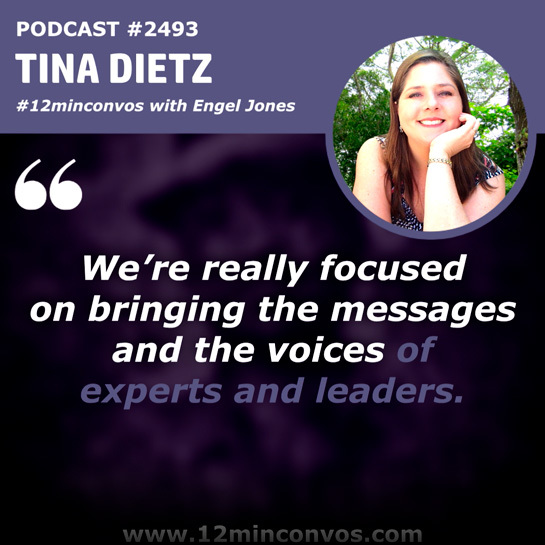
Ep 2493: Twelve Minute Convos w/ Tina Dietz [Podcast]

​I am back with Engel Jones for another amazing Twelve Minute Convos podcast. Such a great concept to spread so many voices(Podcast on Twelve Minute Convos, October, 2019)

twelve minutes convos - Tina Dietz

Tina Dietz is an award-winning and internationally acclaimed speaker, audiobook publisher, podcast producer, and influence marketing expert who has been featured on media outlets including ABC, Inc.com, Huffington Post and Forbes. Tina’s first podcast, The StartSomething Show, was named by INC magazine as one of the top 35 podcasts for entrepreneurs.

In 2016, Tina was the recipient of the Evolutionary Business Council MORE award and in 2017 she received the award for Outstanding Audio Company from The Winner’s Circle. She is also a member of the EBC leadership body and a founding member of the Forbes Coaches Council. Tina was also the lead interviewer in the podcasting documentary “The Messengers” and featured in the film.

Tina splits her time between the US and Costa Rica where she’s part of the leadership team building a community of conscious leaders called Vista Mundo.

Time Stamped Show Notes:

  • How are you doing? [01:01]
  • What’s the latest with you? [01:52]
  • Is the StartSomething Show podcast in hiatus? [03:11]
  • Where is the best place to connect with you? [04:04]
  • On being a stem from an entrepreneurial family. [05:04]
  • Is David in the picture still? [07:13]
  • In closing, is there anything else you’d like to share with our amazing audience? [11:58]

How to Use Audio to Get Your Kids to Learn

Why using audio to get your kids to learn is an easy and convenient way to give them opportunities to become even more well-rounded and well-educated.

Audio Marketing Get Your Kids to Learn - Tina Dietz - audiobook expert

In a world full of distractions like YouTube, thousands of different video games, social media, toys, sports, etc., it’s not always easy to get our kids to learn, much less develop and cultivate their interests and skills. But school is enough, right? Wrong. Everyone learns differently-some visually, some are more hands-on learners, and some learn best through audio, which provides a large variety of ways for kids to learn.

With the rise in popularity of podcasts and audiobooks, more and more ways to help kids get get excited about learning and discover new interests are popping up every day. Using audio to help kids learn is an easy and convenient way to give our kids opportunities to become even more well-rounded and well-educated, hopefully resulting in a young person who grows up to love learning.

Here are some ways you can use audio to get your kids to learn so that you can get started right away. They’ll thank you for it!

Using audiobooks to get kids to learn is different from reading with them and is also very different from just sitting them in front of the TV and allowing them to watch shows (even if they are educational). Listening to audiobooks forces children to use different skills than reading and allows for much more imagination than the TV. Children who find reading difficult can also find great relief in being able to listen to a book. Audiobooks are great for car rides, time when children are self-entertaining while you’re cooking dinner, or even for you to listen to together and discuss after. Some ideas of ways to use audiobooks for children’s learning are:

  • Find fun stories for themThere are tons of audiobooks for children of fun, engaging stories with colorful language for them to use their imaginations, learn words, get excited about listening to the stories, and want to talk about them after.  These can be great conversation starters, so make sure to engage with your child about what you listen to together!
  • Provide sketchbooks and crayons or pencilsThis helps them to further utilize their imagination. While they’re listening, they can draw what they think their favorite characters might look like, strengthening their creativity and encouraging them to use a part of their brain that looking at pictures in books doesn’t activate.
  • In the case of children who find reading difficult, audiobooks can be a tremendous reliefKids can keep up with their schoolwork easier and also become more confident in their reading abilities by listening to an audiobook at the same time that they’re following along with a print or digital version of the book. By engaging more than one of their learning senses at the same time, the brain can integrate the information with more ease.
  • Be close by to answer any questionsIn order for an audiobook to really be engaging and educational, you’ll want to make sure you can define unknown words for them, answer questions about the story as it unfolds, or even just listen to their excitement as they tell you all about what they’re listening to.

More than half of people in the US listen to podcasts weekly, and yes, they can be used for children as well. Many people think that podcasts are always about business or politics, but there are a ton of different podcasts that exist, and many of them are for children! Some teachers utilize podcasts in their classrooms, and you can use them at home to get your kids to learn, too. There are book club podcasts for kids, science ones, fictional stories, and so much more. Podcasts can be utilized similarly to audiobooks to help kids learn, but they can also be used in the following ways:

  • Podcasts offer the advantage of being shorter, and once your child finds one they particularly like, there are usually a whole slew of episodes from that one podcaster from which they can choose.
  • You can have them create their own podcasts! – Free podcast recording software might not be good enough quality to publish, but it IS good enough to encourage your kids to research topics they like or write their own story. Help them record it, have fun with it, and listen to it as a family (or with friends) later. They’ll have something they’re proud of, and it will encourage them to delve further into their interests and passions. It also encourages a use of words that children usually aren’t otherwise engaging.
  • Podcasts are free and easy to download. Put them on your phone, tablet, or even on your computer.

Long story short, there are SO many options when it comes to using audio to help children to learn, and create the beautiful “side effect” of giving you and your kids great conversation topics to explore together. While we still greatly encourage and recommend that you read with your kids and have them read any and all types of books, podcasts and audiobooks are a great addition to any child’s learning and language skills. They’re also an excellent resource for children with learning challenges. Audio teaches all kids to listen for things to talk about later, to develop their imaginations, and develop the ability to ask engaging questions.

Do you have a favorite audiobook or podcast that would be great for kids or families?Please share in the comments, and have fun learning!

Have thought of publishing your audiobook?

What Are Your Favorite Ways to Procrastinate

Ah…procrastination…the “P” word that everyone thinks is bad. Let’s take a look at some favorite ways to procrastinate, while trying to understand why we do it.

Ways to Procrastinate - StartSomething Creative Business Solutions Tina Dietz

Ah…procrastination…the “P” word that everyone thinks is bad, but let’s be honest with ourselves…we all do it. I’m doing it right now by writing this when I could be doing a list of a million other things. It’s a really strange phenomenon that people tend to put off the things that are most important to them. But WHY do we always seem to do it during our most life-changing moments, when there’s something we REALLY want to be doing that could be a path-to-greatness, amazing thing to do? And why do we procrastinate with things we don’t even really want to be doing (like laundry) in place of the awesome ones?

I don’t know the scientific answers to these questions, but I do know my own experiences. I always find myself about to sit down to do something life-changing, and then I think to myself, “Oh, maybe I should just get the dishes done first” or “I should really do my makeup for the webinar I’m doing this afternoon. It’ll just take a minute” or even worse, “I think there’s some laundry that needs to be put away” (the problem here is that there’s ALWAYS laundry that needs to be put away).

Sometimes we WANT to procrastinate, because when you plan everything out and take it slow and calmly, there’s no rush at the end that gives you adrenaline as you race your way to the finish line. Some of us work best in that state of mind, so we actually procrastinate just to get there because it can be kind of a let-down without the excitement at the end.

Some of my absolute favorite ways to procrastinate are folding laundry, email (which can be productive or a big time-waster), and writing blogs like this one. I also always find myself saying, “Well, I was going to make a Facebook Live video later, but maybe I’ll just do one right now,” which isn’t always a bad thing for me because I’m an extrovert, and I thrive off of interacting with my viewers. I’m motivated by it. So, even though I’m procrastinating, it’s productive procrastination.

Productive Procrastination

When I was in grad school, I got into trouble (as I so often did when I was working for someone else) for having individual tutoring sessions with students where I taught them how to procrastinate effectively. Resisting the urge to procrastinate actually does you no good because it causes more stress, which in turn causes the brain to shut down, so you’re just not as effective. The trick is to make sure your calendar is blocked off a full day ahead of time. Acknowledge that you’re probably going to wait until the last second to get it done, but maybe you don’t have to lose sleep to accomplish that. Instead, maybe you can strategically plan your calendar by building in twice as much time as you think you’re going to need so you’re not rushing up against other deadlines (like sleep).

Another trick is to understand that sometimes you just won’t get as much sleep as you really should. Although sleep and self-care are absolutely the best things you can do to help yourself be MORE productive, sometimes you have to get creative with how you’ll get your brain to be fully functioning. One of these ways is to set a number of hours you are going to sleep, sleep that number of hours (no more, no less) during the same hours every night. Then, ideally, during the day, block off 20-30 minutes at the same time every single day for a meditation session or power nap. Keeping your body on a strict schedule like this allows your brain to adjust to routine and operate at full capacity.

If you are a big procrastinator or have “Happy Puppy Syndrome” like me, you tend to wag yourself out and get exhausted because you’ve put TOO much energy into something too quickly. Give yourself 2-3 big priorities each day, and focus on those 2-3 things as your rock for the day. Those are your main points of focus, and everything else just falls in around them.

So, what are your favorite ways to procrastinate? And what are you up to this week? Give yourself 2-3 main priorities each day, and even if it takes you the whole day to do it, that’s okay! Procrastinate away, but do it effectively so you’re not hurting yourself (or your work) in the process.

Want some help figuring out how you can set up some ways to Productive Procrastinate?

How Pissed Off Do You Need To Be To Change?

The key to tapping into anger as a tool is to allow ourselves to go underneath the anger into the underlying commitment behind the anger. Are you pissed off enough to change?

To Change - Tina Dietz

Why did you set the goals for yourself that you’ve set? Why start the business, the book, the project?

I was at a mastermind event with a group of business leaders in Austin, TX led by the incredible Candy Barone and when this subject came up, and the answer was surprisingly consistent among the people in the room.

We had gotten pissed off. Angry. Even righteous….and decided to do something about it.

In the worlds of leadership, personal development, and transformation we often shy away from using or acknowledging anger as a motivating force, but it can be a tremendous source of energy and forward momentum.

The key to tapping into anger as a tool is to allow ourselves to go underneath the anger into the underlying commitment behind the anger.

What we get most fired up about are usually those areas that hold the most meaning for us. Things that aren’t meaningful to us tend to fade in and out of our awareness without leaving a lasting impression.

There’s a deep commitment that you have to something underneath the emotional fire, something that calls you to react strongly and feel motivated to respond and take action. Now imagine using that automatic motivation, that intense rush of energy, and putting it to use towards effective action that is in alignment with your commitment, your values, your passion.

For your brain and business ‘food’ this week and viewing pleasure, here’s what we’re discussing:

  • Tapping into what gets you angry as a tool to create more clarity
  • Aligning your goals with your values
  • Red flags to pay attention to when it comes to anger
  • Using your anger as a directional needle to get more focused
  • How to direct your anger and upset into productive, clear action.

What do you get fired up about and what’s your underlying commitment that triggers that response? Let’s get the conversation going and unleash your voice – the world needs you!

Ready to turn that anger into a productive business?

Is This Mistake Sabotaging Your Leadership?

Heather Parbst, business development and team building maven, agreed to share her expertise and thoughts on the topic of leadership sabotage, particularly for women leaders but these issues can extend across age, gender, etc. SOAK THIS IN.

women leaders - Tina Dietz & Heather Parbst

What do you think of this statement?

I, too, am a “doer.” I’ve always taken pride in this title. People know they can count on me, that I will be responsible and produce a good product. Throughout my career, this was my modus operandi. I worked hard, doing more than my fair share and assuming the responsibilities of others when they were quite capable of doing it themselves. Then, I would feel resentful when others didn’t acknowledge my efforts or step in to take some of the work off my plate.

Holy.Crap.

When I read these words from business development and team building maven Heather Parbst, I felt as though I had written them myself. Can you relate?

So today, Heather agreed to share her expertise and thoughts on the topic of leadership sabotage, particularly for women leaders but these issues can extend across age, gender, etc. SOAK THIS IN.

Work hard and reap the benefits. That’s what you’ve done so far in your career and it has worked to propel you forward. You are known as a “doer.” You get it done, whatever “it” is. People describe you as competent and dependable. They know they can count on you. It has been your hard work and sweat that have gotten you to where you are.

Women often think that our sweat alone is the primary driver of our success. People will see our abilities for what they are based on: our work product and the amount of effort we extend. We work hard to prove our competence and to show that we bring value. This works great in school. Work hard, get the good grade. Work hard, get into the good school. Work hard, get the promotion. You see where I am going. It works… until it doesn’t.

Let me explain.

I, too, am a “doer.” I’ve always taken pride in this title. People know they can count on me, that I will be responsible and produce a good product. Throughout my career, this was my modus operandi. I worked hard, doing more than my fair share and assuming the responsibilities of others when they were quite capable of doing it themselves. Then, I would feel resentful when others didn’t acknowledge my efforts or step in to take some of the work off my plate.

Prior to a leadership role, this was a personal aggravation. But, once I was heading up a team, it became a massive bottleneck. Instead of empowering my team, my actions said, “I don’t believe in you to do this work, so I will do it myself” or “You don’t have to do this work. I will take care of it for you.” Meanwhile, my burning the candle at both ends was standing in the way of my business success and causing me to burn out. And it certainly was not scalable.

Gender-Bias Is a Factor

There is a natural tendency for women to “over-row the boat,” as Susan MacKenty Brady, chief strategist with Linkage Inc., likes to say. This is partly due to gender bias. A well-known illustration of gender bias at play is the 2012 study by Yale University where 100 fictional, identical resumes for a lab manager position were sent to 100 faculty members nationwide to assess what their hiring decisions would be based solely on the resumes. The only difference between the resumes was that half bore the name “John” and the other half said “Jennifer.” You probably know the story. John was rated more competent and hirable, and he was given a salary of $4,000 more annually than Jennifer. Despite both candidates having the exact same qualifications, Jennifer was perceived as less deserving of the job. Hopefully you can see how this sets Jennifer up for having to work significantly harder to demonstrate her value.

We Do It to Ourselves Too

But, gender bias is only part of the problem. Our own false beliefs about work, worth and competence also play a role in why we work ourselves ragged. Inside, we may secretly wish that someone else, our spouse, our boss, our coworker, will see how much we are contributing and acknowledge our efforts. This can be particularly true if we struggle with talking about our ourselves, our own strengths and accomplishments. We may simply be scared to give up control for fear of things not being done to our expectations or standards. Or we believe that by doing it all at or near perfection proves our value and eliminates the chance that others may question whether we are deserving.

What Got Us Here Won’t Get Us There

Thinking in this way is a tragedy. Why? Because the “do it all at 110%” approach that got us the job or powered us through starting our business will sabotage us as leaders. Midway through our careers, instead of hitting our stride and putting our accumulated knowledge and skills to work, we feel exhausted and just want a break. When we are best poised to use our talents to lead others forward to greatness, we are longing instead for a long rest.

Stop Hyper-Performing and Start Delegating

Hyper-performing will certainly help us to a point, but our personal energy isn’t scalable and, frankly, over-performing is exhausting! At a certain point, if we want to continue to increase our impact, we must change our approach. The shift here is to learn how to leverage the talents and gifts of those around us. Instead of drawing on our ability to power through and do it all, we need to draw on our other skills, like collaboration and communication. 

We need to level up our mindset, rising above thoughts like, “I want to advance my career, take on this role, grow this business by doing X, but I just don’t know how I’ll get it all done.” We must understand that the work is not all for us to do. We enlist others. We empower others to do their jobs and to build their skills along the way. We ask others to help. Our new way of thinking sounds like, “I want to accomplish X. How can I inspire others to help me and how do I leverage their talents to get it done?”

It’s Not All About You

Sometimes the most difficult hurdle to this mental shift is getting past the belief that our delegation is self-serving. You protecting your own sanity is good for everybody! By easing your burdens so that you can focus on your true priorities in a way that best utilizes your skills and prevents burnout, you are driving your entire team forward and setting an excellent example of quality leadership. You are also creating opportunities for your team to expound on their skills. Remember that when you choose to do it all, you are limiting their success (let that last one soak in for a minute).

So, whether you are dealing with “Team Work” or “Team Family,” the answer to getting it all done and increasing your impact is the same—stop doing it all yourself.

Recruit assistance, delegate and scale!

Heather Parbst is the founder of Clarity3 Consulting, a firm focused on helping entrepreneurs grow strong, healthy businesses. She founded Clarity3 after selling her own IT company and wanting to help others achieve entrepreneurial success. Having a background in behavioral science and experience as a CEO and business owner, Heather brings a unique perspective to the world of entrepreneurship and leadership. She particularly enjoys working with women to grow as leaders and scale their businesses.

Heather Parbst – Business development & team building maven

Ready to step into a new level of leadership and break through old, self-sabotaging habits and beliefs?

Is Resistance Keeping You From What You Want?

Your resistance may be keeping you from what you want and not allowing you to get stuff done. And this is the type of resistance I’m talking about here: The most common type of resistance I see in creative people.

What You Want - Tina Dietz

VIVE LA RESISTANCE!!!!

No. Nope. Definitely Not. That’s the last thing we need.

Resistance keeps us from having what we want and getting stuff done.

How many times have you had a phenomenal idea but not acted on it, and then you see someone else making it happen?

Do you know how long it took me to break through my resistance to offer the audiobook production and publishing services in my business that I’m now known for?

4 YEARS

The type of resistance I encountered and ultimately (thank goodness!) overcame is a very common type of resistance I see in creative people.

In essence, this type of resistance is the result of a fear/concern that the vision we have for our idea might not match the reality. The fear of things not working out is crushing to the point where we’d rather have the fantasy than risk the reality of possible disappointment.

There are two other types of resistance that are unfortunately common but fortunately very ‘treatable’ once you know what you’re dealing with.

Resistance Type 2 is when you’re up against the need to learn something new, and you know it would probably be good for you and benefit you, but you just can’t generate any energy around learning this new skill or doing what needs to be done.

Often this is a situation of “I CAN learn this, but I hate it.” Or, “Yeah, I can do this but it takes me forever/I don’t like it/there’s so many other things I could be doing.”

FOMO (Fear Of Missing Out) is also the source of this type of resistance. It’s so easy to get pulled off track by wanting to jump on a trend or new bit of technology.

Alleviating this type of resistance is best served by bringing in more teamwork – either with your colleagues or by hiring someone – or by getting creative and finding a solution that’s better suited to your strengths and priorities. 

And then there’s Resistance Type 3...I start discussing the finer points of this resistance at 4:03 into the video, and really you want to listen to this part there if you haven’t listened to the entire 6 minutes already.

Either you’ll laugh or you’ll want to slap me. Possibly both. Let me know.

This week, observe where you’re experiencing some resistance and see where you can find more creative solutions, bring in more teamwork, and/or get out of your own way. What type of resistance are you dealing with?

Ready to break through your resistance and get results?

How To Create The Year You REALLY Want

Here are several key elements that you need to create the year you really want.

The Year Your Really Want - Tina Dietz

Did your 2018 start with a bang, or a whimper?

When it comes to creating a satisfying, fulfilling year, I’ve learned that taking time to create what Stephen Covey would’ve called “big rocks” (major goals) at the beginning of each year is key.

Do you set up a vision and goals for yourself each year?

​Here are several key elements that you need to achieve what’s most important to you THIS YEAR.

  1. ​Remember creating the vision of your Perfect Day? Once you have that vision, take a moment to bring up how it feels in your body, mind, and spirit. Take note of the feelings and sensations, and write them down.​​**Pro Tip: by remembering how the emotions and body sensations feel, you can practice bringing those feelings and sensations up in your body, mind, and spirit on a daily basis. Feeling amazing takes PRACTICE, and this is a fabulous mental discipline.​
  2. Choose 1-3 key feeling terms that you want to guide or characterize your year. In 2018, my husband and I chose to make this the year of Curiosity & Wonder. You already know I’m a HUGE fan of curiosity as a tool to give ourselves access to more courage, dispel fear, and increase our productivity and focus. Adding Wonder to the mix allows me to truly enjoy the journey, find beauty in small things, and engage my ‘beginners mind’ and allow more contribution from others.​**Pro Tip: Setting goals and actions in a space of physical and mental space that is positive will result in very different decision making than a space of fear, constriction, or control.​
  3. Set 2 primary business or professional outcomes and 2 primary personal outcomes for 2018. The old saying goes…​“Most people overestimate what they can do in one year and underestimate what they can do in ten years.”​It’s more important to focus on a couple of primary outcomes that are the most important and impactful to you, rather than a laundry list that’s overwhelming.​
  4. For each of your 2 biz and 2 personal outcomes, create “horizons” that help you turn your big outcomes into smaller ones. I call these smaller goals or outcomes “horizons” because they represent, in a metaphorical sense, about how far out into the future you can “see.” In other words, when you’re eating an elephant, the horizons are the “one bite at a time” part of that meal.**Pro Tip: I set my Horizons to be every 2 months, then review, assess, and refresh for the next two months.

Left to our own devices, goal setting can seem a little overwhelming at times. There’s creating the Vision, then creating the steps between your current world and what you want to create, and then implementing it all! Right now, you may not know all you’ll need to know to have the outcome you want actually HAPPEN.

It’s ok, just take the first step by declaring what you want, and then part of the process is figuring out the how.

Check the video below for more ways to create the year you really want, plus more detailed tips, techniques, and inspiration!

Ready to create an incredible year? Schedule a Discovery Call and let’s explore working together to bring your vision into reality

4 Steps To Properly Leverage Your Time – Barb Stuhlemmer – S2Ep20

Leverage Your Time - Tina Dietz & Barb Stuhlemmer

How To Properly Leverage Your Time w/ Barb Stuhlemmer

Time is the one resource we can’t renew and we can’t get back. We’re always looking for more time for both business and pleasure. So what’s the deal? Why do we all seem to struggle with time?

In the past, Barb Stuhlemmer and I talked about the differences between an entrepreneur struggling to get by and someone who is already very successful-how each group deals with time is a BIG differentiating factor. Barb returns in this episode to talk with us about dealing effectively with time and how you can properly leverage your time…without getting a clone.

Barb is a Master Business Strategist whose goal it is to inspire Ambitious Business Growth so entrepreneurs, that are super-visionaries, can reach the million and multi-million dollar mark in their business and live their biggest dreams. Barb provides strategic guidance in her business BLITZ Business Success to create Product & Client Identification Plans (what to sell, how to price it, where to sell it, and who to sell to), helping successful business owners, who are driven by big ideas, create new paths in their business and life so they can truly enjoy what they do and successfully live in their passion all the time.

What You’ll Learn From This Episode:

  • The importance of having systems to manage your time
  • How managing your time can make a huge difference in your life
  • Why the term “Time Management” can be controversial
  • What you can do differently to manage how you go through time
  • The importance of creating a strategy for what you really want to do
  • Four easy steps to better manage your time
  • How to keep track of your time (without hating it)
  • What tracking your time allows you to assess
  • Determining your time goals
  • What are “S.M.A.R.T.A.R goals?”
  • The importance, as a business owner, to leverage someone else’s time
  • The role your kids play in leveraging your time
  • Good systems to use in your business to better leverage your time
  • Using automation to better leverage your time-you don’t have to be technical
  • Barb’s legacy for the world.

Featured on the Show:

StartSomething-Show-Stitcher-SubscribeStartSomething-Show-subscribe-with-itunesGoogle-Play-Music-en-badge-webStartSomething Show Tina Dietz

3 Ways Entrepreneurs Kill Their Productivity

How much time do you spend collecting information, certifications, and more training? Yep, these are some of the ways entrepreneurs kill their productivity.

ways entrepreneurs kill their productivity - Tina Dietz

There has rarely been a better time in history to start a business. In 2013, more than 135,000 jobs were added to the US market and guess where nearly half those jobs came from? SMALL businesses. To really make it as an entrepreneur you need tremendous tenacity, top notch networking skills, and a no-fear approach to sales—even in the most heart-centered of business ventures. But if you’re reading this, I’m probably not telling you anything new yet, and what you want is to break through to the next level of time and money freedom in your business.

Every industry I’ve worked with-and there have been more than 20+ industries internationally-has its own unique quirks and challenges. However, some very common trends arise when it comes to how you’re likely to sabotage yourself regarding time and your productivity.

Productivity Killer #1: The “Perpetual Expert”

Collecting information is only useful if it is immediately practical. If you have a client who has a question, look it up. Google is your friend, and problem solving when there’s actually no problem is a drain of time, energy, and resources. The brain only retains about 10% of the information that it is exposed to, so chances are you’re going to have to look it up again anyway if you need it at all. Your time is better spent finding out what your ideal clients need, and focusing on filling those needs in a targeted and concise manner.

Productivity Killer #2: Having an Open Schedule

There’s a difference between being available and being a 24/7 hotline. Have a policy that you will always return communications within a certain amount of time (say 12, 24, or 48 hours) and honor that policy. This gives you room to breathe, builds trust with your clients, and also sets clear expectations. People value a service more when they know they have to plan for it, and most “emergencies” resolve themselves or quickly become non-emergencies if you don’t feed the energy of a knee-jerk reaction. Limit checking your email and voice mail to 2-3 times a day for a half hour at a time. Unless it’s someone you’re waiting to hear from, don’t pick up your phone when it rings. These practices will have you focus on your most important tasks and keep your responses to the point.

Productivity Killer #3: Being Too Friendly

This goes for both colleagues and clients. Obviously you don’t want to be a jerk, but it’s completely doable to be kind even when you’re setting a boundary or saying no. Gossip, social media, and instant messaging, and other kinds of chitchat can wipe out hours of your day, leaving you frustrated and scrambling to get your priorities handled. The same goes for meetings. Start by wearing a phone headset (in the case of an office setting) or putting a “please do not disturb” sign on your office door if you have one (even at home) to reduce distractions and interruptions. Minimize your time in live or phone meetings by partnering up with a colleague and trading off going to meetings and taking notes for each other. As for clients, steer clear of personal entanglements. If you’re with a client who is on a roll with a personal story, reach over and give a gentle, compassionate squeeze to their shoulder or hand and say, “you’re really going through some difficulty right now, so why don’t we take a step back and see where I can best help you.” You can then redirect the conversation to a more solution-focused place. Don’t be afraid to interrupt them, they will thank you for it later.

Can’t wait to hear your thoughts. Let me know in the comments if you have any of these “killers.”

  • 1
  • 2

Pin It on Pinterest